Inventory and pricing engineered
for pharmaceutical manufacturers

Inventory and pricing engineered
for pharmaceutical manufacturers

plans that hold

CURIO is a vertical AI platform designed to support pharmaceutical manufacturers in designing, simulating, and optimising inventory and pricing across medium- to long-term planning horizons.

It integrates data, industrial constraints, and advanced decision models within highly regulated and complex environments.
Horizontal planning platforms weren't built for pharma's complexity. CURIO AI was.
The only Vertical AI platform designed from the ground up for pharmaceutical manufacturers.

Integrates data for end-to-end visibility

Profiter AI is trained exclusively on pharmaceutical supply chain dynamics, the only Vertical AI engine built natively for this domain. CURIO surfaces that intelligence through a collaborative interface your planners can work with directly.

Applies pharma-specific machine learning models

Algorithms designed and trained within the pharmaceutical domain, not generic models adapted afterward.
Simulates scenarios, impacts, and trade-offs

Every inventory and pricing decision is evaluated for its impact on service levels, costs, margins, and working capital.

Supports measurable and traceable decisions

Each decision is supported by KPIs, traceable decision history, and reliability indicators.

Connects operational planning with financial budgeting

Demand forecasts, inventory strategies, and pricing decisions are translated into measurable financial outcomes.
Budgets originate from operational models—not from static assumptions based on historical data.


Trusted by pharmaceutical manufacturers

Bayer

Germany

Automating inbound order management from e-commerce channels across a three-party network of brands, logistics providers, and pharmacy customers. CURIO delivers the end-to-end operational visibility that makes demand-driven replenishment possible at scale.

DOC Farmaceutici

Italy

Integrating exogenous market signals — competitor dynamics, regulatory shifts, demand variability — directly into production planning cycles. DOC Farmaceutici moved from static historical assumptions to adaptive, forward-looking industrial scheduling.

Trusted by pharmaceutical manufacturers

Bayer

Germany

Automating inbound order management from e-commerce channels across a three-party network of brands, logistics providers, and pharmacy customers. CURIO delivers the end-to-end operational visibility that makes demand-driven replenishment possible at scale.

DOC Farmaceutici

Italy

Integrating exogenous market signals — competitor dynamics, regulatory shifts, demand variability — directly into production planning cycles. DOC Farmaceutici moved from static historical assumptions to adaptive, forward-looking industrial scheduling.

Trusted by pharmaceutical manufacturers

Bayer

Germany

Automating inbound order management from e-commerce channels across a three-party network of brands, logistics providers, and pharmacy customers. CURIO delivers the end-to-end operational visibility that makes demand-driven replenishment possible at scale.

DOC Farmaceutici

Italy

Integrating exogenous market signals — competitor dynamics, regulatory shifts, demand variability — directly into production planning cycles. DOC Farmaceutici moved from static historical assumptions to adaptive, forward-looking industrial scheduling.

Inventory designed in advance, not corrected afterward

CURIO, our AI collaboration interface, enables companies to engineer inventory decisions, balancing service levels, logistics and production costs, working capital, and supply constraints.

Reliable demand forecasting

Integrates historical data, seasonality, market trends, and external signals to produce robust forecasts for critical SKUs, supporting S&OP processes.

Sourcing and procurement management

CURIO evaluates the impact of long lead times, simulates alternative suppliers, and proactively identifies critical materials.

Demand–production–quality alignment

Models incorporate production capacity, batch logic, GMP constraints, and raw material availability.

Scenario analysis

Operational simulations for demand fluctuations, supply disruptions, regulatory constraints, and production planning changes.

Reliable demand forecasting

Integrates historical data, seasonality, market trends, and external signals to produce robust forecasts for critical SKUs, supporting S&OP processes.

Demand–production–quality alignment

Models incorporate production capacity, batch logic, GMP constraints, and raw material availability.

Sourcing and procurement management

CURIO evaluates the impact of long lead times, simulates alternative suppliers, and proactively identifies critical materials.

Scenario analysis

Operational simulations for demand fluctuations, supply disruptions, regulatory constraints, and production planning changes.

Problems it solves

Inventory decisions based on unreliable forecasts

Reduced average inventory and improved capital efficiency

Shortages on critical SKUs

Greater service continuity for distributors and customers

Rigid and non-adaptive planning

Ability to recalibrate decisions without disrupting existing plans

Bayer and DOC Farmaceutici already rely on CURIO for pharmaceutical supply chain planning. Not because it promised transformation — because it delivered it.
Manufacturers working with CURIO don't add complexity to their planning. They remove it.

Pricing engineered alongside demand, costs, and availability — not managed in isolation.

In contexts where pricing plays a strategic role (B2B environments, indirect channels, international markets), CURIO supports dynamic pricing strategies integrated with forecast demand, industrial costs, and production capacity.

Pricing isn't an isolated lever. In pharmaceutical manufacturing, it's a structural planning variable — interconnected with batch economics, procurement commitments, and production capacity. CURIO treats it that way.
Forecast-driven pricing

Pricing decisions are evaluated based on their impact on volumes, turnover, and service levels.
Integration with industrial costs

Models incorporate production costs, sourcing costs, batch constraints, and operational realities.

Margin and availability simulations

Ex-ante evaluation of how pricing changes affect margins, inventory levels, and capacity utilisation.

Inventory–pricing alignment

Price and availability are planned together, avoiding unsustainable demand or unprofitable stock.

Problems it solves

Prices disconnected from demand forecasts

More stable and consistent pricing strategies

Margin erosion

Protection of profitability in volatile scenarios

Supply chain instability

Alignment between pricing, production, and inventory

The technology behind the decisions

CURIO is powered by Profiter AI, our proprietary vertical AI engine, which harmonises all company data sources through CURIO Core, the central data hub.

Multiple connectors

REST APIs and integrations with ERP, WMS, and SCM systems

Native demand & sales forecasting

Transforms observed historical demand into forward-looking volume forecasts

Multilayer Data Fusion

Integration of external data sources (e.g., AIFA, Farmadati, population flows, logistics, weather, promotions, competitors)

Multi-role dashboards

Views tailored for Operations, Supply Chain, and Finance teams

Intelligent normalisation

Data reconciliation, anomaly detection, and operational data quality management

Generative AI layer (optional)

Natural language interaction and proactive insights

Multiple connectors

REST APIs and integrations with ERP, WMS, and SCM systems

Multilayer Data Fusion

Integration of external data sources (e.g., AIFA, Farmadati, population flows, logistics, weather, promotions, competitors)

Intelligent normalisation

Data reconciliation, anomaly detection, and operational data quality management

Native demand & sales forecasting

Transforms observed historical demand into forward-looking volume forecasts

Multi-role dashboards

Views tailored for Operations, Supply Chain, and Finance teams

Generative AI layer (optional)

Natural language interaction and proactive insights

Multiple connectors

REST APIs and integrations with ERP, WMS, and SCM systems

Intelligent normalisation

Data reconciliation, anomaly detection, and operational data quality management

Multi-role dashboards

Views tailored for Operations, Supply Chain, and Finance teams

Multilayer Data Fusion

Integration of external data sources (e.g., AIFA, Farmadati, population flows, logistics, weather, promotions, competitors)

Native demand & sales forecasting

Transforms observed historical demand into forward-looking volume forecasts

Generative AI layer (optional)

Natural language interaction and proactive insights

01 · DATA FOUNDATION AND FORECAST RELIABILITY
Data Model IT

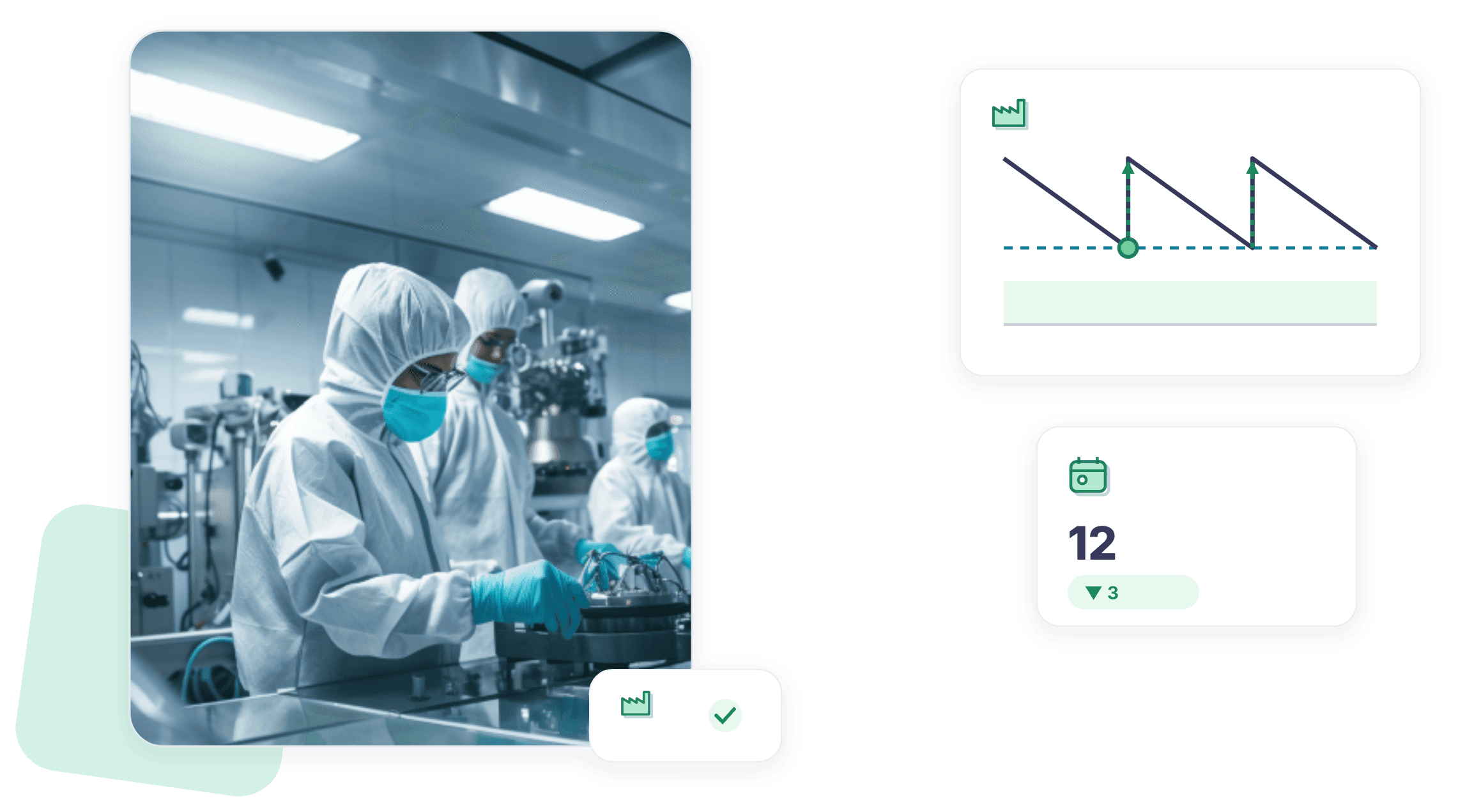
A normalised relational data model integrating demand, stock, product master data, batches, lead times, markets, and warehouses. It reconciles heterogeneous data from ERP, quality systems, and supply chain platforms.

BENEFITS +

A single, reliable data foundation for planning, simulations, and AI. Eliminates inconsistencies across functions and markets.

Multi-Horizon AI Forecast

Short-, medium-, and long-term demand forecasts (30–365 days) with reliability metrics such as MAE, MAPE, and variance. SKU-market level forecasts aligned with annual planning.

BENEFITS +

Early visibility of real demand, support for S&OP and industrial planning, and reduced uncertainty for critical products.

Data Normalization & Quality

Normalisation and reconciliation of data flows (sales, stock, production, supply). Automatic detection of anomalies, outliers, data gaps, and operational distortions.

BENEFITS +

Decisions based on clean, comparable data. Reduced planning errors caused by incomplete or inconsistent information.

Customised AI Model

AI engine trained on company data and continuously updated through operational feedback, market events, and supply changes.

BENEFITS +

Forecasts that reflect real business dynamics and adapt to structural and regulatory shifts.

Data Model IT

A normalised relational data model integrating demand, stock, product master data, batches, lead times, markets, and warehouses. It reconciles heterogeneous data from ERP, quality systems, and supply chain platforms.

BENEFITS +

A single, reliable data foundation for planning, simulations, and AI. Eliminates inconsistencies across functions and markets.

Data Normalization & Quality

Normalisation and reconciliation of data flows (sales, stock, production, supply). Automatic detection of anomalies, outliers, data gaps, and operational distortions.

BENEFITS +

Decisions based on clean, comparable data. Reduced planning errors caused by incomplete or inconsistent information.

Multi-Horizon AI Forecast

Short-, medium-, and long-term demand forecasts (30–365 days) with reliability metrics such as MAE, MAPE, and variance. SKU-market level forecasts aligned with annual planning.

BENEFITS +

Early visibility of real demand, support for S&OP and industrial planning, and reduced uncertainty for critical products.

Customised AI Model

AI engine trained on company data and continuously updated through operational feedback, market events, and supply changes.

BENEFITS +

Forecasts that reflect real business dynamics and adapt to structural and regulatory shifts.

02 · SCENARIO LOGIC AND OPTIMISATION

Scenario & What-If Planning

Multi-scenario simulations for changes in demand, lead times, production capacity, regulatory constraints, and supply disruptions.

BENEFITS +

Faster evaluation of impacts and stronger support for strategic decisions and continuity planning.

Inventory Optimisation

Optimisation of procurement quantities and stock levels considering MOQ, capacity constraints, logistics limits, and service targets.

BENEFITS +

Lower capital lock-up, improved resource utilisation, and greater supply chain resilience.

Lifecycle Management

Integrated product lifecycle management: phase-in, active, slow-moving, and phase-out, maintaining continuity across related or substitute products.

BENEFITS +

Consistent planning during portfolio changes without forecasting gaps or distortions.

Dynamic Safety Stock

Automatic safety stock calculation based on demand variability, lead times, service levels, and product criticality.

BENEFITS +

Better balance between availability and working capital. Reduced stockout risk on critical products.

Advanced SKU Classification

Classification based on volume, demand regularity, and criticality using objective thresholds.

BENEFITS +

Scientific prioritization of products and materials, improved cost control, and targeted service levels.

Slow & Obsolete Stock Management

Automatic identification of slow-moving or obsolete inventory with operational recommendations (reduction, reallocation, disposal).

BENEFITS +

Waste reduction, value recovery, and improved financial efficiency.

Scenario & What-If Planning

Multi-scenario simulations for changes in demand, lead times, production capacity, regulatory constraints, and supply disruptions.

BENEFITS +

Faster evaluation of impacts and stronger support for strategic decisions and continuity planning.

Dynamic Safety Stock

Automatic safety stock calculation based on demand variability, lead times, service levels, and product criticality.

BENEFITS +

Better balance between availability and working capital. Reduced stockout risk on critical products.

Inventory Optimisation

Optimisation of procurement quantities and stock levels considering MOQ, capacity constraints, logistics limits, and service targets.

BENEFITS +

Lower capital lock-up, improved resource utilisation, and greater supply chain resilience.

Advanced SKU Classification

Classification based on volume, demand regularity, and criticality using objective thresholds.

BENEFITS +

Scientific prioritization of products and materials, improved cost control, and targeted service levels.

Lifecycle Management

Integrated product lifecycle management: phase-in, active, slow-moving, and phase-out, maintaining continuity across related or substitute products.

BENEFITS +

Consistent planning during portfolio changes without forecasting gaps or distortions.

Slow & Obsolete Stock Management

Automatic identification of slow-moving or obsolete inventory with operational recommendations (reduction, reallocation, disposal).

BENEFITS +

Waste reduction, value recovery, and improved financial efficiency.

03 · GOVERNANCE AND OPERATIONAL CONTROL

Operational KPI & Control Tower

Calculation of KPIs for coverage, turnover, service levels, stockout risk, and forecast reliability, with views tailored for operations and supply chain teams.

BENEFITS +

Continuous performance monitoring and operational improvement.

Governance HQ

Centralized governance of stock policies, procurement strategies, and service targets across plants, warehouses, and markets.

BENEFITS +

Consistency across the supply chain and reduced local decision distortions.

Alerts & Exception Management

Alert system for exception management such as critical stock levels, forecast deviations, and supply delays.

BENEFITS +

Operational responsiveness and focus on high-value activities.

Operational KPI & Control Tower

Calculation of KPIs for coverage, turnover, service levels, stockout risk, and forecast reliability, with views tailored for operations and supply chain teams.

BENEFITS +

Continuous performance monitoring and operational improvement.

Alerts & Exception Management

Alert system for exception management such as critical stock levels, forecast deviations, and supply delays.

BENEFITS +

Operational responsiveness and focus on high-value activities.

Governance HQ

Centralized governance of stock policies, procurement strategies, and service targets across plants, warehouses, and markets.

BENEFITS +

Consistency across the supply chain and reduced local decision distortions.

04 · REPORTING, INTEGRATION AND FINANCIAL PLANNING

Advanced Reporting

Traceable reporting on forecasts, inventory, deviations, and performance drivers, exportable to corporate BI systems.

BENEFITS +

Decision transparency and alignment across departments.

ESG Inventory Analytics

ESG KPI monitoring for obsolescence, product destruction, service levels, and environmental impact of inventory.

BENEFITS +

Support for EU compliance and reduced waste across the supply chain.

Integrated Forecast Budgeting

Budget creation and rolling forecasts (6–12 months) derived directly from demand, inventory planning, and industrial costs.

BENEFITS +

Alignment between operational and financial planning and more reliable financial projections.

API & Integration Layer

APIs enabling bidirectional integration with ERP, SCM, WMS, and analytics platforms.

BENEFITS +

Seamless integration with the existing IT ecosystem and automation of decision processes.

Continuous Enablement

Monthly feature releases, dedicated training, and ongoing support for Supply Chain and Operations teams.

BENEFITS +

Fast adoption, knowledge transfer, and a platform that evolves with business needs.

Advanced Reporting

Traceable reporting on forecasts, inventory, deviations, and performance drivers, exportable to corporate BI systems.

BENEFITS +

Decision transparency and alignment across departments.

API & Integration Layer

APIs enabling bidirectional integration with ERP, SCM, WMS, and analytics platforms.

BENEFITS +

Seamless integration with the existing IT ecosystem and automation of decision processes.

ESG Inventory Analytics

ESG KPI monitoring for obsolescence, product destruction, service levels, and environmental impact of inventory.

BENEFITS +

Support for EU compliance and reduced waste across the supply chain.

Continuous Enablement

Monthly feature releases, dedicated training, and ongoing support for Supply Chain and Operations teams.

BENEFITS +

Fast adoption, knowledge transfer, and a platform that evolves with business needs.

Integrated Forecast Budgeting

Budget creation and rolling forecasts (6–12 months) derived directly from demand, inventory planning, and industrial costs.

BENEFITS +

Alignment between operational and financial planning and more reliable financial projections.

Optional Add-On (Inventory)

GenAI Inventory

AI assistant using natural language to analyse inventory, costs, forecasts, and operational scenarios.
Supports both operational teams and executives in understanding data and identifying decision levers.

ADVANTAGES+

An AI decision assistant trained on company data capable of answering questions on KPIs, inventory, and forecasts; explaining anomalies; suggesting actions aligned with planning models and industrial constraints

Budget & Financial Planning

Designed for CFOs and Finance leaders who want to manage industrial budgets starting from reliable operational data.

Generates forward-looking P&L scenarios and rolling forecasts based on demand and inventory planning integrated with financial models.

ADVANTAGES+

Structural alignment between operational and financial planning.
Budgets that are more consistent, traceable, and continuously updated across Supply Chain, Operations, and Finance.

01 · COST AND MARKET INTELLIGENCE

Cost & Margin Intelligence

Unit and batch cost modelling (raw materials, production, logistics, quality). Margin calculation by SKU, product line, market, and channel, integrated with regulatory and industrial constraints.

BENEFITS +

True visibility on industrial profitability and pricing decisions based on reliable data.

Market Price Benchmarking

Collection and normalisation of market price data (wholesale, tenders, regulated channels). Competitive analysis by SKU, geography, and positioning.

BENEFITS +

Better understanding of market positioning and stronger strategic pricing decisions.

Cost & Margin Intelligence

Unit and batch cost modelling (raw materials, production, logistics, quality). Margin calculation by SKU, product line, market, and channel, integrated with regulatory and industrial constraints.

BENEFITS +

True visibility on industrial profitability and pricing decisions based on reliable data.

Market Price Benchmarking

Collection and normalisation of market price data (wholesale, tenders, regulated channels). Competitive analysis by SKU, geography, and positioning.

BENEFITS +

Better understanding of market positioning and stronger strategic pricing decisions.

02 · PRICING AND ELASTICITY SIMULATION

Price Scenario Simulation

Simulation of pricing scenarios across medium- and long-term horizons, evaluating impacts on demand, volumes, margins, and capacity saturation.

BENEFITS +

Lower decision risk and the ability to evaluate alternatives before acting.

What-If Pricing & Market Events

Simulations based on external events such as market shortages, regulatory changes, and competitor entry or exit.

BENEFITS +

Stronger strategic resilience and preparedness for complex market scenarios.

Demand Elasticity Modeling

Analysis of price-demand elasticity across key SKUs and categories, distinguishing structural changes from temporary fluctuations.

BENEFITS +

More sustainable pricing aligned with real market behavior and greater stability in volumes and margins.

Price Scenario Simulation

Simulation of pricing scenarios across medium- and long-term horizons, evaluating impacts on demand, volumes, margins, and capacity saturation.

BENEFITS +

Lower decision risk and the ability to evaluate alternatives before acting.

Demand Elasticity Modeling

Analysis of price-demand elasticity across key SKUs and categories, distinguishing structural changes from temporary fluctuations.

BENEFITS +

More sustainable pricing aligned with real market behavior and greater stability in volumes and margins.

What-If Pricing & Market Events

Simulations based on external events such as market shortages, regulatory changes, and competitor entry or exit.

BENEFITS +

Stronger strategic resilience and preparedness for complex market scenarios.

03 · INVENTORY AND KPI ALIGNMENT

Price & Inventory Alignment

Alignment between pricing policies, inventory levels, and production plans with simulation of combined impacts.

BENEFITS +

Consistency between industrial planning and pricing decisions, reducing overstock, shortages, and production inefficiencies.

Pricing & Margin KPIs

Advanced KPIs for margin performance, price volatility, and forecast vs. actual deviations with full decision traceability.

BENEFITS +

Managerial transparency and continuous performance improvement.

Price & Inventory Alignment

Alignment between pricing policies, inventory levels, and production plans with simulation of combined impacts.

BENEFITS +

Consistency between industrial planning and pricing decisions, reducing overstock, shortages, and production inefficiencies.

Pricing & Margin KPIs

Advanced KPIs for margin performance, price volatility, and forecast vs. actual deviations with full decision traceability.

BENEFITS +

Managerial transparency and continuous performance improvement.

Optional Add-On (Pricing)

GenAI Market & Margin Assistant

AI assistant for natural-language analysis of costs, prices, margins, and market scenarios, delivering proactive insights and explanations.

ADVANTAGES+

Faster decision-making, executive support, and reduced analytical workload for teams.

Want to see CURIO applied to your supply chain?

Your inventory, pricing, and budget decisions — connected by one pharmaceutical AI platform. Built to hold under pressure.